A folded plan sheet has one job: when it’s sitting in a stack in the job box, you should be able to read the sheet number without opening it.
That means the title block ends up on the outside. Everything else about folding blueprints follows from that one rule.
Here’s how to do it on an Arch D sheet, the size about 90% of our blueprint printing orders come in, and how to adjust for the other sizes.
The Rule: Title Block Out
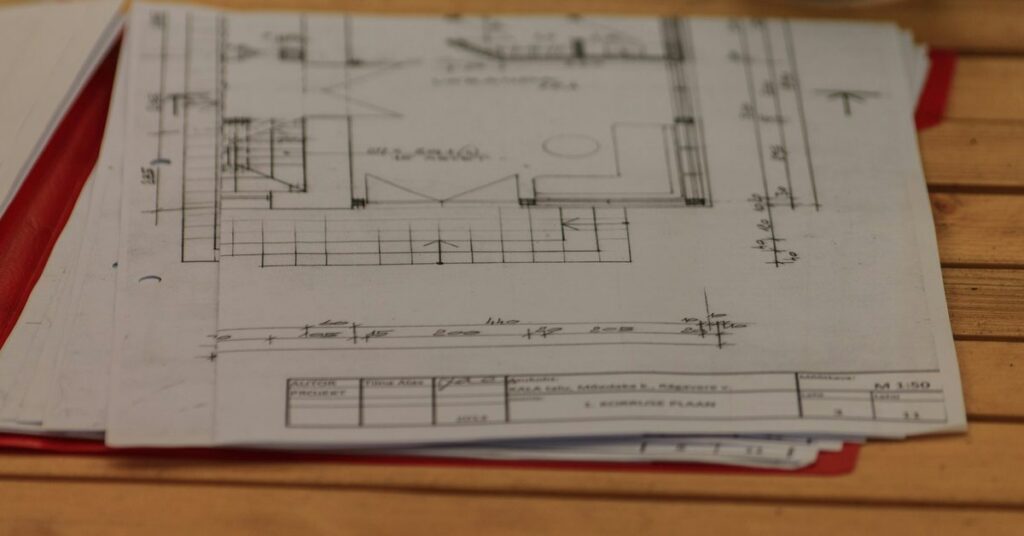
The title block is the box in the bottom-right corner of every sheet. It carries the sheet number, the sheet title, the project name, the revision date, and the engineer’s or architect’s information.
Fold so that box lands on the front face of the folded sheet, right side up. Do that and a stack of twenty folded sheets reads like a file drawer: thumb through, find S-201, pull it.
Fold it any other way and every sheet has to be opened to find out what it is. On a tailgate, that’s how sheets get torn and lost.
How to Fold an Arch D Sheet (24×36) to 9×12
Two moves. The first one runs along the 36-inch side, the second along the 24-inch side.
Move 1: Accordion fold the long side into four 9-inch panels.
- Lay the sheet face up, title block in the bottom-right corner.
- Starting from the left edge, fold the first 9 inches under.
- Fold the next 9 inches back over the top, then the next 9 under. Fan-fold, like a paper map, working toward the right.
- You finish with the right-hand panel, the one with the title block, face up on top.
You now have a strip 9 inches wide and 24 inches tall, with the title block at the bottom of the face-up panel.
Move 2: Fold the strip in half, top half going back.
- Fold the top 12 inches of the strip back, behind the bottom half.
- You’re holding a 9×12 packet with the title block in the lower right of the front face.
That’s it. 9×12 happens to be Arch A, so a folded Arch D sheet lands at a standard size that fits a 10×13 envelope, a letter-width file box, or a job box divider.
Two habits that make it work:
- Crease with the side of your fist, not a fingernail. You want flat folds, not a scored line that tears on the third opening.
- Line up the edges before you crease. A fold that wanders a quarter inch at the top will be off by an inch by the time you’re done, and the packet won’t stack square.
Folding the Other Sizes
The method doesn’t change. Fan-fold the long side first, fold the short side second, title block out.
| Sheet | Size | Long side | Short side | Folds to |
|---|---|---|---|---|
| 11×17 | 11″ × 17″ | Fold in half | None | 8.5×11 |
| Arch C | 18″ × 24″ | Fold in half (two 12″ panels) | Fold in half | 9×12 |
| Arch D | 24″ × 36″ | Fan-fold into four 9″ panels | Fold in half | 9×12 |
| Arch E | 36″ × 48″ | Fan-fold into five panels, about 9.6″ each | Fold into thirds | About 9.6×12 |
Arch E is where folding stops being worth it. Five panels one way and thirds the other is a thick packet, and a 36×48 sheet is awkward to fold on anything smaller than a plan table. If you’re working an Arch E set, think about rolling it instead.
Not sure which size you’re holding? The Arch C, D, and E size guide walks through how to tell.
Fold or Roll?
Both are right. They’re for different places.
Fold when the set is going somewhere it’ll get handled.
- The job box, the truck, the trailer
- Field copies a crew is going to pull one sheet from at a time
- Shipping flat, in a FedEx box or envelope
- Anything that needs to sit in a file drawer by sheet number
Roll when the set is going somewhere it’ll be laid out whole.
- A plan table at the trailer or the office
- Presentation sets for an owner meeting
- Shipping in a tube
- Short-term storage when nobody’s going to pull single sheets
Don’t fold a bound set. If the sheets are stapled or strip-bound along one edge, folding through the binding cracks it and the set never lies flat again. Bound sets get rolled or stored flat.
Keep the record set flat if you can. For a set you need to last, the Northeast Document Conservation Center’s guidance on storing oversized paper says what archivists tell architects: flat in a drawer is best, and rolled around a tube is next. Fold lines are where old sheets wear through first. That’s fine for a field set you’ll reprint anyway. It’s not what you want for the as-built set that has to survive a lawsuit or a remodel twenty years out.
What a Folded Set Does in the Field
The point of folding isn’t neatness. It’s that a folded field set behaves.
A rolled Arch D set on a tailgate wants to roll back up, and in any wind it leaves. Weighted down with a tape measure and a coffee, it still curls at the corners. A folded set opens to one sheet, gets read, gets marked up, and goes back in the stack in the right place.
That matters more than it sounds. The sheet that gets left in the truck cab because it was too much trouble to roll back up is the sheet that’s missing when the inspector asks for it.
For the field sheets that get marked up hardest, a lot of crews skip full size entirely and run 11×17 copies. More on that in Field Copies, Bid Sets, and Redlines.
Ordering Your Set Already Folded
You don’t have to fold anything yourself. When you order a set from us, pick folded or rolled on the order form.
- Job site delivery goes out folded, in a large zip-top bag with a Precision label that carries the order info, dropped where you tell us. We deliver in Charlotte (including North Port), Sarasota, DeSoto, and Lee counties.
- FedEx 2-Day, anywhere in Florida, ships either way: folded flat or rolled in a tube.
- Walk-in pickup at the Port Charlotte print room, folded or rolled, your call.
Most orders that reach us during business hours go out the same day. Upload the PDF at pblueprints.com, tell us how many sets and folded or rolled, and we’ll confirm the sheet size before anything runs.
Precision Blueprint Co. is a division of Creek Engineering.
FAQ
How do you fold a 24×36 blueprint?
Lay it face up with the title block in the bottom-right corner. Fan-fold the 36-inch side into four 9-inch panels, starting from the left, so the title block panel ends face up on top. Then fold the top half of the strip back behind the bottom half. You end up with a 9×12 packet with the title block showing on the front.
Why should the title block face out?
So you can identify the sheet without opening it. The title block carries the sheet number, title, and revision date. With it on the outside, a stack of folded sheets can be flipped through like a file drawer.
Is it better to fold or roll blueprints?
Fold sets that will be handled one sheet at a time: job box, truck, field copies, flat shipping. Roll sets that will be laid out whole on a plan table, presentation sets, and anything shipped in a tube. For long-term storage of a record set, flat is best and rolled is second.
Can you fold a stapled or bound plan set?
Not well. Folding through a staple or strip binding cracks it and the set won’t lie flat afterward. Roll bound sets or store them flat.
What size does a folded Arch D sheet end up?
9×12 inches if you fan-fold the long side into four panels and fold the short side in half. That’s Arch A size, which fits a 10×13 envelope.
Can I order plans already folded?
Yes. Choose folded or rolled when you order. Job site deliveries go out folded in a labeled zip-top bag.